
Robots behaving badly VS what the land knows
Algorithmic colonialism, environmental narratives, plus an upcoming chat with Jeff.
Boozhoo News River Readers,
This week we’ve got a funding announcement from Genome Canada, an article on how harvesting narratives serve as primary environmental data, and a freshly printed paper on algorithmic colonialism.
And an invitation to the virtual conversation happening next Wednrsday with Jeff 😉
We appreciate the time you spend here!
Here’s this week’s stories:
Genome Canada, Genome Prairie Launch $50M National Resources Initiative
What the land knows: Métis harvesting narratives as climate knowledge
Robots Behaving Badly: Algorithmic Colonialism and the Consequences of AI
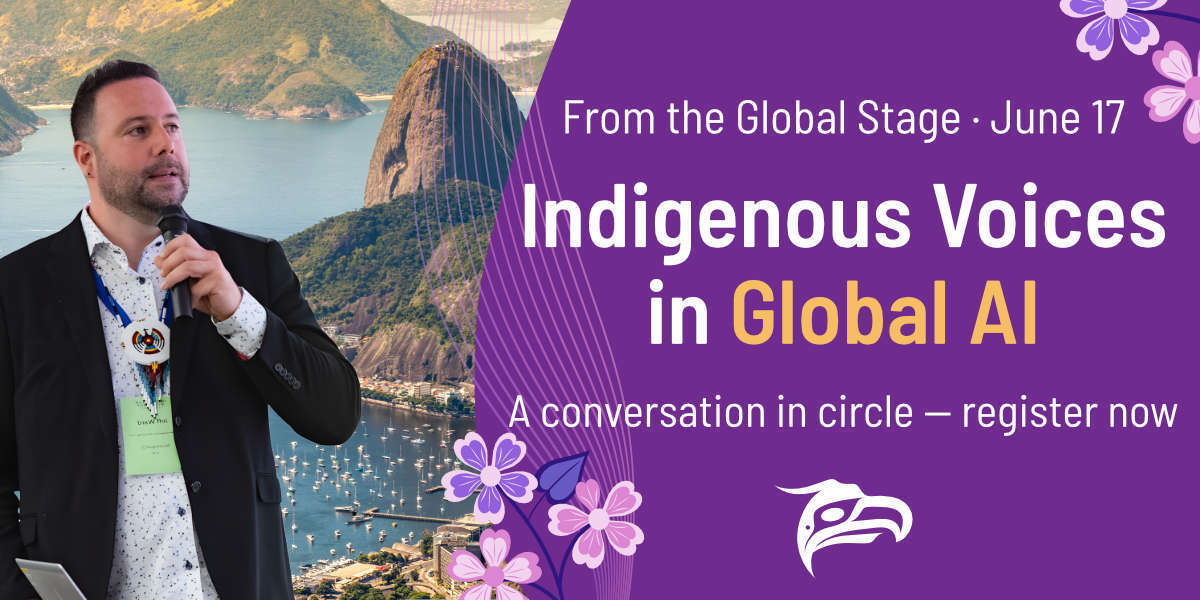
Circle conversation with Jeff is one ☝️ week away
The big picture: Jeff Ward will be sharing reflections from recent international travel and conversations about AI - through an Indigenous lens.
Why it matters: We’re initiating this conversation because we want your thoughts on what comes next. When you register, you have the opportunity to submit your most pressing question, and we’re seeing some great themes emerge from the 80+ people who’ve already signed up.
What you want to know: So far the responses highlight questions of practical implementation, community capacity and wise practices - relating to governance, consent, ownership, etc - as AI developments accelerate.
Learn more: Indigenous Voices in Global AI: A Conversation in Circle, Wednesday, June 17, 2026, 11:00 am PT / 2:00 pm ET. Register here.
Curated Articles:
Genome Canada, Genome Prairie Launch $50M National Resources Initiative
Genome Canada, in partnership with Canada’s genomics enterprise, including Genome Prairie, today unveiled its latest large-scale mission-driven research initiative, the Natural Resources Initiative (NRI). The NRI is a three-year, $50M investment, with $25M in Government of Canada support, to lay the foundations for a generational transformation of Canada’s resource systems and biodiversity management. The NRI will be rolled out via three integrated activity streams: Stream 1: Driver Projects: This mission-driven stream focuses on addressing challenges facing the nation’s natural resource systems. This stream will seek ways to improve biodiversity monitoring, develop sustainable resource management strategies, climate adaptation, and protect ecosystems. Stream 2: National Genomics Data Hub: this stream is focused on developing a platform to oversee data generated by Stream 1 project activities. Stream 3: Indigenous Data Governance Frameworks: this stream will develop tools for Indigenous genomic and environmental data to be owned, accessed, utilized, shared, and appropriately stewarded beyond the NRI opportunity.
Robots Behaving Badly: Algorithmic Colonialism and the Consequences of AI
This article examines the political, social, and relational consequences of artificial intelligence through an anti-colonial and Indigenous lens. Challenging claims that AI is neutral or inevitable, we show that it is embedded in settler-colonial, racialised, and gendered power structures. Across predictive policing, facial recognition, automated welfare, deepfake sexual violence, and embodied robotics, AI does not malfunction; it performs exactly as designed, reproducing historical domination. Drawing on Indigenous methodologies and critiques of technological progress, we show how AI amplifies epistemic and material inequalities, particularly for Indigenous women and communities. We unsettle Western techno-futurist imaginaries and instead position Indigenous relationality as a pathway to ethical, accountable, and sovereign AI futures. AI harm is not accidental but systemic and extractive. We call for rejecting AI inevitability and advancing community-led responses that disrupt algorithmic settler colonialism and reimagine intelligence beyond domination.
What the land knows: Métis harvesting narratives as climate knowledge
This case study argues that Métis harvesting narratives are not supplementary data. They are primary data that predate the colonial institutions’ reliance on scientific data. The dominant frameworks for understanding climate change and the impacts on the environment were built by the same colonial project that spent three centuries actively removing Métis people from the territories they understood best. That the resulting knowledge gap is now being addressed with consultation processes and Traditional Ecological Knowledge annexes is not quite enough. The stories are the data. The rest is catching up. My experience as a Métis harvester in Treaty 6 territory is treated throughout this paper as evidence, not as illustration and not as colour, but as data.
Kimberley Aboriginal Law and Culture Centre champions Indigenous data rights at AIATSIS Summit
Leaders from the Kimberley Aboriginal Law and Culture Centre (KALACC) are championing Indigenous Data Sovereignty at this year's Australian Institute of Aboriginal and Torres Strait Islander Studies (AIATSIS) summit. The five-day summit, held on the Gold Coast, embraced the theme 'Our Truth. Our Power. Our Future'. One of its key conferences focused on sustaining Indigenous Data Sovereignty. Indigenous Data Sovereignty means that Aboriginal and Torres Strait Islander peoples have control over information collected about their communities, Country, cultures, and lives. Data should only be gathered or used with Indigenous leadership, consent, and clear benefits for the community. At its core, Indigenous Data Sovereignty is about self-determination.
Indigenous Knowledge in the Digital Age: Learning, Preserving, Sharing
At the UNESCO Campus, students from different parts of the world came together to discuss one of today’s key challenges: how to preserve Indigenous knowledge and languages while embracing new technologies. The discussions focused on the role of technology and education in preserving Indigenous knowledge. Audrey-Maud Perreault, a consultant supporting UNESCO's International Decade of Indigenous Languages (2022–2032) highlighted how digital tools can help document languages and traditions, with Indigenous youth already developing mobile applications to share knowledge. However, she indicated that technology must be used ethically, with clear respect for ownership and cultural protocols. Many Indigenous languages are disappearing, but digital platforms, speech technologies, and online learning can support their preservation. Still, she underlined that true preservation depends on community control and participation. Both experts believe that Indigenous Peoples must be involved from the beginning of any initiative by ensuring they remain owners of their data, knowledge, and cultural heritage.

Add a comment: