
EARLY EDITION: In conversation with Jeff
Last-chance registration, design notes from Tom Spetter, and a new land-based research facility!
Boozhoo News River Readers,
You’ll notice this email is arriving in your inbox a few hours early today! We wanted to give folks one last chance to register for today’s vitual conversation with Jeff! Registration numbers have far exceeded our expectations, and we thank our dedicated News River readers for that!
Final Reminder - happening TODAY:
Indigenous Voices in Global AI: A Conversation in Circle with Jeff Ward, Wednesday, June 17, 2026, 11:00 am PT / 2:00 pm ET. Register here.
This week we've got stories about a land-based research facility, community-led archaeology, and women and AI skills. Thanks for the time you spend reading our News River!
This week’s stories include:

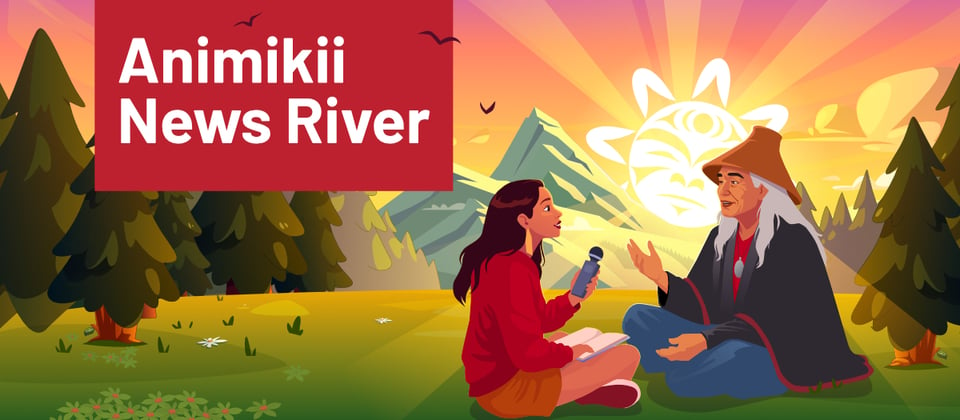
About our seasonal headers - with Animikii’s Tom Spetter
The big picture: Ahead of each solstice and equinox our Lead Designer Tom Spetter creates a new illustrated header for the top of our News River. As this weekend is the summer solstice and also National Indigenous Peoples day here in Canada, we thought we’d share more context for this season's image - straight from the artist.
Tom is a Tla-o-qui-aht First Nation member and is honoured to work and live with his family on the traditional territory of the Lək̓ʷəŋən (Lkwungen, Songhees and Esquimalt) Peoples of the Coast Salish Nation. We hope you’ll appreciate how personal this one is, too.
Tom’s reflections:
An elder is shown in traditional regalia, wearing a black robe and a woven cedar hat with split bark detailing, grounding the piece in our visual culture.
The cedar hat carries personal meaning. Last year my sister, my wife and I harvested the cedar bark together. This summer, now that the bark has aged and shrunk, we will soak it, cut it into strips and learn to weave these hats from my mom and auntie, so the design reflects a living practice being passed down in real time.
The scene captures the act of passing down and storing knowledge between generations, with the elder sharing and a younger person recording and listening.
It speaks to our culture's foundation in oral history, where knowledge has traditionally been carried through the spoken word.
With so few fluent natural language speakers remaining, the image makes the case that we should enlist technology to help preserve this knowledge for future generations.
The sun motif behind the elder ties the natural setting to cultural identity and the idea of knowledge as something that gives life and light.
Curated Articles:
Canada cannot be a global technology leader when Indigenous communities are left offline
Canada has become very good at talking about being a global technology leader. Our government talks about artificial intelligence, quantum computing, clean energy and the race to build a modern economy. Ministers at podiums describe Canada as an innovator, a forward-looking leader, a country ready to compete with the world's best. Then, in communities like mine, the video call freezes. That is the part of the national innovation story that rarely makes it into the speech. Many rural, remote and Indigenous communities still cannot count on the basic internet connection needed to take part in that future. In Muscowpetung Saulteaux Nation, we are only about 60 kilometres north of Regina's city centre. That is close enough to see the glow of our digital economy, but far enough to understand how inequitably it has been built. For years, our members were expected to participate in a modern economy without the infrastructure that participation requires.
Women, AI and digital skills in Guatemala
In rural Guatemala, a teacher uses AI for math lessons that include Indigenous culture. Her work and that of other Mayan women illustrate how AI and media literacy can strengthen cultural identity and civic engagement. Like many teachers today, Mayary Cutzal Xon has long been suspicious of artificial intelligence (AI) – both for herself and for her students. How can teachers make wise decisions using AI in lesson plans, and will that enhance – or hinder – a student’s understanding of the world? Add to those doubts that southwest rural Guatemela, where she lives and works, is already at risk of gradually losing its ancient culture and ancestral heritage thanks to encroaching forces like digital and social media – for Mayary Cutzal Xon, there's this sense that "belonging to a non-dominant culture is a disadvantage," she said. This tension came into focus recently when she decided to test AI in a math lesson. Instead of using apples or pears in equations, she used AI to design scenarios that included huipiles, which are hand-woven Mayan blouses where the thread, color and pattern tell the story of its origin.
Concern in NWT about impact of Kevin O’Leary’s Alberta AI data centre
The head of Keepers of the Water says the group’s members “definitely have concerns” with a celebrity-backed AI data centre being planned in northwestern Alberta. Jesse Cardinal is the executive director of the Indigenous-led coalition, which focuses on water protection within the Arctic Ocean drainage basin. She said the Wonder Valley AI Data Centre – backed by investor Kevin O’Leary of Dragon’s Den fame – will use “massive amounts of fresh water” from the Smoky River, a major tributary of the Peace River. She said both rivers have experienced low water levels in recent years. Downstream, the Peace River joins the Athabasca River in the Peace-Athabaca Delta to form the Slave River, a tributary of the Mackenzie River. “We had a conference in March where we had people all the way from the Inuvialuit communities and we’re hearing the same thing, no matter where people come from – that the water levels have declined drastically,” Cardinal said. US-based developer O’Leary Ventures has promoted the $70-billion Wonder Valley AI Data Centre as “the largest AI computer data centre park on Earth.”
The University of Ottawa and Vanderbilt University are working together to advance Indigenous-led knowledge preservation and research through a new international agreement. The University of Ottawa (uOttawa) signed a new memorandum of understanding with Vanderbilt University, marking the beginning of a strategic partnership centered on Indigenous digital archives and the Ottawa Mobile History Lab. The agreement reflects the institutions' shared commitment to advancing respectful, community-engaged research and supporting the preservation of Indigenous knowledge through collaborative and digitally enabled approaches. The collaboration brings together two institutions with complementary strengths in research, digital scholarship, and international collaboration. The collaboration will support work on Indigenous digital archives and the Ottawa Mobile History Lab in ways that recognize the importance of Indigenous data sovereignty, community-led archival practices, ethical stewardship, and reciprocal knowledge exchange. By emphasizing care, respect, and long-term relationship building, the collaboration aims to contribute to archival and research practices that are accountable to the communities whose histories and knowledge systems are involved.
Project receives federal funding to ‘bring life back’ to Barrier Lake Field Station building. Leason’s vision for the facility is that it will transform the research culture at the University of Calgary, and how Indigenous research is applied in the real world and train a new generation of researchers. “Research is only as good as the impact it has in community,” she says. “The impact will be measured by the relationships, the bringing folks together, the inclusion of First Nations, Métis and Inuit students, and the opportunities that we create for them and for generations to come.” Leason, a member of the Minegoziibe Anishinabe Nation in Manitoba, and collaborators Drs. Deborah McGregor and Yvonne Poitras Pratt, both PhD, have been awarded a Canada Foundation for Innovation John R. Evans Leadership Fund (CFI JELF) grant to transform the old building into the Indigenous Interdisciplinary Land-based Research Space, the first of its kind in Canada.
Community-led indigenous archaeology in Canada
Dr. Kisha Supernant, Director of the Institute of Prairie and Indigenous Archaeology at the University of Alberta, examines community-led Indigenous archaeology in Canada. For much of the twentieth century, archaeologists in Canada studied Indigenous histories largely without the involvement of the living descendants of the peoples whose sites, belongings, and ancestors were being excavated. Archaeologists often treated Indigenous peoples as subjects of study rather than as the rightful stewards of their own cultural heritage. Belongings and ancestral remains were removed from communities and taken to colonial institutions, where they were studied and displayed without consent. Over the past several decades, Indigenous communities have increasingly challenged these approaches and called for greater authority over how their cultural heritage is managed and interpreted. In response, Indigenous archaeology has emerged as a collaborative and community-centred approach to archaeological practice.

Add a comment: