
Psst - Jeff’s hosting a circle on June 17th
News River readers get first access!
Boozhoo News River Readers,
June is here and so are the conversations and reflections from proud parents celebrating the accomplishments of the youth and grads in their lives! We’ve got stories about Indigenous-led cohorts, summer programs, and projects in the environmental and science space.
We’ve also got an exciting announcement featured below and you’re the first to hear about it!
Thanks for the time you spend reading our News River - if you’ve got news or a story you’d like to contribute, you can always hit reply and send us the link!
This week’s stories include:
Six new projects to explore impacts of plastic pollution on Indigenous communities
Yukon founder joins national Indigenous AI program as Fireweed gains traction
Meet Some of Canada’s First Indigenous Environmental Science Program Grads
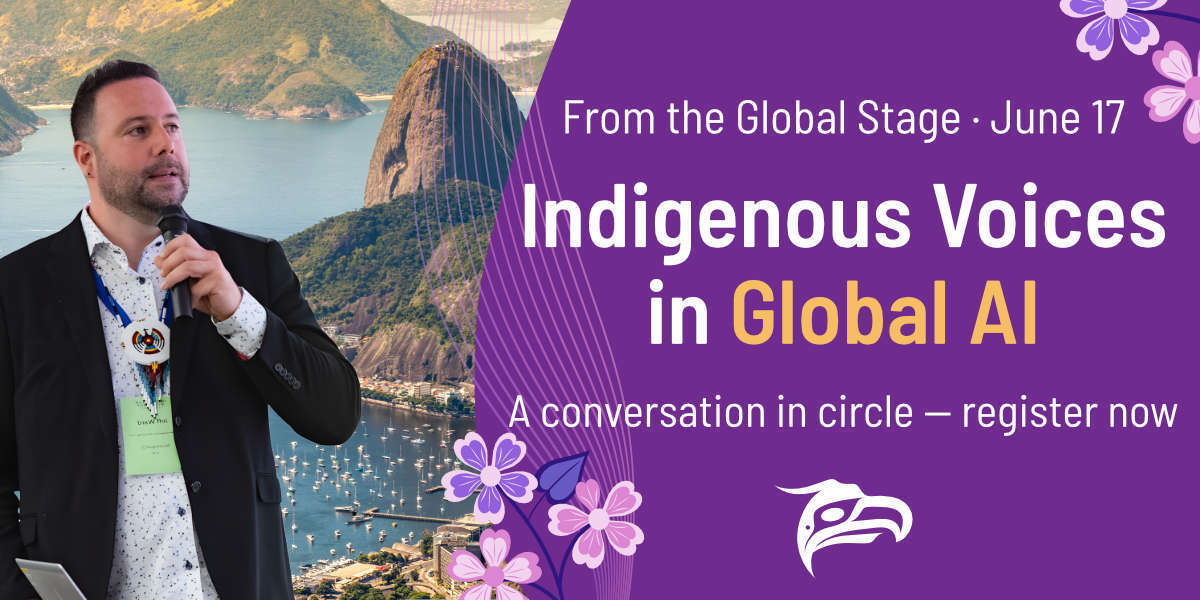
Jeff’s hosting a circle on June 17th - and you’re invited!
The big picture: Jeff Ward went to Rio for the GPAI Innovation Workshop. He's bringing the conversation home and wants your thoughts on what comes next. News River readers get first access TODAY!
Why it matters: On Wednesday, June 17 Jeff will share what he heard at the workshop in Rio, and will also gather input from you, our network. This conversation also connects to Jeff's recent appointment to the Indigenous AI Advisory Circle convened by @Mila and @CIFAR to guide Canada's AI institutes.
Key points: The 4th GPAI Innovation Workshop, hosted by LNCC with CEIMIA, Inria, and NICT, brought together researchers and governments around four themes:
AI literacy and informed agency
Cooperation frameworks for AI governance
AI from local data
Cultural diversity in AI training
Each theme looks different through an Indigenous lens, and Jeff wants to talk about this with the people whose work sits next to ours.
Learn more: Indigenous Voices in Global AI: A Conversation in Circle Wednesday, June 17, 2026, 11:00 am PT / 2:00 pm ET. Register here.
Curated Articles:
Yukon founder joins national Indigenous AI program as Fireweed gains traction
Cole Robulack, founder and CEO of Fireweed AI, has been selected for Mila’s Indigenous Pathfinders program, marking a national milestone for the four‑month‑old Yukon startup building AI systems for First Nations. The seven‑week program brings Indigenous participants to Montréal for hands‑on AI training and community‑centred project development, according to a news release issued May 28. Robulack, a Vuntut Gwitchin citizen and electrical engineering student at UBC Okanagan, said the cohort includes engineers, artists, healthcare workers, journalists, and entrepreneurs from across Canada, all trying to answer the same question about what AI should do for Indigenous communities rather than what corporations decide. Fireweed’s work, he said, is part of a push for northern control in the AI space. The company is building infrastructure that keeps First Nations data in Canada and under First Nations’ own authority, instead of sending it to large U.S.-based AI platforms.
Panelists discuss data sovereignty at Toronto conference
Rylee Restoule is getting busier and busier. Restoule, a member of Dokis First Nation, is the clinical research coordinator of Indigenous health at the Sudbury-based Health Sciences North Research Institute (HSNRI). Restoule was also recently in Toronto attending the Chiefs of Ontario Powering Up Data Sovereignty conference. The three-day event concluded on May 14. Restoule was a panellist for an opening-day session titled Approaches to Implementation: Regional Overviews and Perspectives on First Nations Data Sovereignty. “We have increasing requests from education and healthcare and other organizations for research,” she said. “And obviously, when communities don’t have these works in place, they’re left in a really vulnerable position.” Restoule also said there is an increasing interest in data governance work. And officials are learning plenty of lessons along the journey.
Six new projects to explore impacts of plastic pollution on Indigenous communities
Plastic pollution is found nearly everywhere on Earth and threatens ecosystems, wildlife, and potentially human health. What is Canada doing about it? Most recently, the federal Ministry of the Environment, Climate Change and Nature has announced nearly $2.4 million in research funding to help deepen its understanding of the social, cultural, and economic impacts of plastic pollution on Indigenous communities. This initiative, launched in partnership with the Social Sciences and Humanities Research Council of Canada, will support six Indigenous-led and co-led projects over two years. In addition to examining the effects of plastic pollution on wildlife, the environment, and human health, these six projects will provide training and mentorship opportunities for students and emerging scholars, helping to build capacity at the intersection of Indigenous Knowledge systems, social sciences, and environmental research.
Civil Society Summit on the AI Industry - Event recordings now available
The Civil Society Summit on the AI Industry is an opportunity to slow down and take a close, critical look at what is being decided and implemented on our behalf, without any meaningful public consultation. We’ll hear from organizations confronting the "upstream"of AI: data centres’ water and energy use, climate impacts, mineral extraction, electronic waste, and violations of Indigenous rights. And we’ll discuss the downstream effects: impacts on mental health, online sexual violence, workplace surveillance, deskilling workers, devaluing labour, collapse of social trust, intensification of fossil fuel production, automation of artistic and cultural practice, undermining Indigenous data sovereignty, racial profiling and algorithm-facilitated discrimination. The Summit is organized by the Council of Canadians with support from the Starling Centre and the Trebek Fellowship funded by the Alex Trebek Forum for Dialogue.
What is Indigenous Cultural Intellectual Property: An explainer
In simple terms, Indigenous Cultural Intellectual Property asks the question: "Who has the right to know, use, share, record, interpret, benefit from, or commercialise Indigenous knowledge and culture?" When people hear the words “intellectual property”, they often think of patents, copyright, trademarks or commercial inventions. But for Aboriginal and Torres Strait Islander Peoples, knowledge is not always owned or protected in those Western legal categories. Indigenous Cultural and Intellectual Property, often shortened to ICIP, is a broader way of talking about First Peoples’ rights to their cultural heritage, traditional knowledge and cultural expressions. Terri Janke describes ICIP as ':grounded in Indigenous peoples’ right to self-determination, and it can include cultural practices, languages, stories, plant knowledge, spiritual knowledge, cultural objects, environmental resources, ancestral remains, genetic materials, sites of significance, and documentation of Indigenous heritage and histories".
Meet Some of Canada’s First Indigenous Environmental Science Program Grads
When Ava Augustine began exploring university programs, she was drawn to the environment and engineering disciplines, but it was a unique program at the University of Guelph that changed her perspective. This June, Augustine will cross the convocation stage as part of the inaugural graduating cohort of the Bachelor of Indigenous Environmental Science and Practice (BIESP) program – the first undergraduate degree of its kind in Canada. “The program appealed to me because of its foundation in learning with and for Indigenous Peoples,” says Augustine. The program braids together Western environmental science with Indigenous Knowledge Systems and land-based practices, preparing graduates with both the scientific expertise and cultural competency required to work with Indigenous communities. “As a settler student, it is a privilege to be welcomed into learning with Indigenous communities and to build meaningful relationships,” says Augustine, who aspires to pursue a career in scientific communication and advocacy after graduation. The program’s two-eyed seeing approach is a defining feature of the program.

Add a comment: