
Indigenous-led futures in the north
Plus: a new climate-focused graphic novel by Indigenous youth
Boozhoo News River Readers,
Some weeks the news curates itself! We’ve got three interesting stories related to Indigenous leadership, major projects (and impacts on communities) in the north. Also a story about a new graphic novel that brings Indigenous youth voices and climate research to life, and overview of an online trust and safety training workshop!
Thanks for reading our News River,
This week’s stories include:
New Arctic Observing Summit Report Calls for Indigenous-Led Future in Arctic Science
Decisions on major projects often ignore cultural and social losses
$10M backs northern research facility and Indigenous data platform
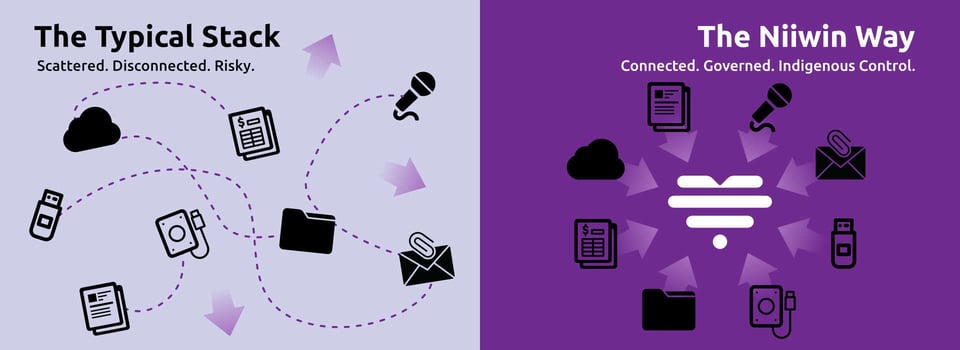
Custom Community Archives with Niiwin
The big picture: Data storage is where implementing OCAP® and CARE principals start. Whoever governs the working data of archival projects - decides which questions it can answer and what the community eventually learns.
Why it matters: It’s about one important decision, made early: where will all of the data live while we work on this project, and who holds the keys? Answer it before the first interview is recorded, if you’re just starting. Write it into the data-sharing agreement and everything else follows.
What we’re hearing: Jeff, our CEO reminds us often: "Indigenous data sovereignty principles are good for everybody." Indigenous communities named the problem first, built the principles to confront it, and now Animikii is building the tools to help turn those principles into practice.
Learn more: If you are planning research with a community and the storage question is still open, talk to us -
Curated Articles:
Canada’s AI strategy must reckon with the environmental implications of data centres
When Sturgeon Lake Cree Nation went to court recently to challenge Alberta’s handling of the proposed Wonder Valley AI Data Centre Park project, the dispute underscored a question that is increasingly difficult to ignore: What does Canada’s artificial intelligence future require from land, water and energy systems? Wonder Valley, which would be located south of Grande Prairie, has been advertised as the world’s largest AI data centre park. Alberta’s major projects listing describes its first phase as a 1.4-gigawatt off-grid power system leveraging the provincial natural gas and geothermal resources. The project is only one example of a broader trend. The federal government’s new “AI for All” strategy links AI to economic growth, jobs and national competitiveness. The strategy also points to expanding “sovereign compute” and supporting the construction of large-scale AI data centres. These ambitions make the environmental debates significant. AI is often described as if it lives in “the cloud.” The persistent controversies regarding Wonder Valley illustrate the fallacy of this metaphor. Artificial intelligence relies on material resources: land, electricity, water, cooling systems, transmission lines, gas infrastructure, minerals and servers. When those demands become concentrated in one place, AI becomes an environmental and energy issue.
New graphic novel brings Indigenous youth voices and climate research to life
Waakebiness Institute for Indigenous Health (WIIH) project translates public health research into creative, community-driven storytelling. The Gathering Place: Toaando, produced by WIIH at the Dalla Lana School of Public Health, transforms research on the climate crisis and its disproportionate effects on Indigenous youth in Toronto into a compelling story of a wanderer learning from their community. Dr. Suzanne Stewart, lead investigator on the project, says, “Translating public health research into community-centered formats isn’t just a ‘nice-to-have’ communication strategy; it is a fundamental requirement of Indigenous research ethics, data sovereignty, and health equity.” The central research question of The Gathering Place graphic novel is: What are the mental health impacts of climate change for Indigenous youth and what services are needed to support youth? “The project began with an initial research phase that helped inform the story and its themes. Following this, a team of youth collaboratively developed the narrative through storyboarding sessions,” says Faulk. “Throughout the process, Knowledge Keepers Sioux Lamure and Elder Luana Shirt guided the work to ensure the story remained culturally safe and stayed true to the youths’ original vision and messaging.”
$10M backs northern research facility and Indigenous data platform
The Canada Foundation for Innovation marked National Indigenous Peoples Day yesterday with the first investments from its Northern Fund, a research infrastructure program designed for northern institutions and communities. The two investments total $10 million, split between $5 million from the Northern Fund and $5 million from CFI’s Infrastructure Operating Fund, which covers ongoing maintenance costs. Two Nunavut-based organizations split the funding equally. SIKU, the Indigenous Knowledge App, is a digital platform built by the Arctic Eider Society in Sanikiluaq, Nunavut. It has more than 40,000 users across northern communities and supports more than 100 community-led research and environmental monitoring projects. The platform brings together Indigenous Knowledge and scientific approaches for work ranging from sea ice and climate studies to wildlife ecology.Indigenous data sovereignty is a core design principle of the platform. Users own their data, and no one can use it without permission. The $5 million will fund software, digital storage, and AI analysis and data visualization tools so communities can run their own research programs on the platform.
New Arctic Observing Summit Report Calls for Indigenous-Led Future in Arctic Science
A newly released report from the Arctic Observing Summit 2026 is calling for a fundamental shift in how Arctic research and monitoring are conducted, placing Indigenous leadership, community priorities, and societal benefits at the center of future observing systems. The report summarizes discussions and recommendations from the Arctic Observing Summit, held in Aarhus, Denmark, from March 30 to April 1, 2026, during Arctic Science Summit Week. Together, they argue that Arctic observing systems must evolve beyond traditional scientific data collection to better support communities confronting rapid environmental and social change. Throughout the summit, participants emphasized that Indigenous knowledge should be recognized as an equal and essential foundation for Arctic observation, research, and decision-making. The report highlights the need for stronger Indigenous governance, long-term community partnerships, equitable funding structures, and greater support for Indigenous-led monitoring initiatives. The summit concluded with a series of recommendations directed at governments, research institutions, and funding agencies. Among them were calls for Indigenous data sovereignty, dedicated funding for community partnerships, expanded support for early-career researchers, and the development of more inclusive measures of success for Arctic observing programs.
Decisions on major projects often ignore cultural and social losses
Impact evaluations can make deep community harms look like acceptable trade-offs when they are treated as costs to be measured and balanced. In public debates over pipelines, mines, dams and other major infrastructure projects, governments often make assurances that any communities or other parties adversely affected by the development will be “compensated” for losses. The language sounds fair and rational: Impacts to lands and people that remain after mitigation will be measured, damages calculated, and payments provided to those who experience negative impacts. The problem is more fundamental than simply the flawed methodologies used to evaluate environmental damages and assess compensation, which typically focus on tangible losses that can be counted — jobs eliminated, fish harvests lost, acres flooded or revenues forgone. It is also structural, built into current systems to support certain economic interests while ignoring those of affected communities. As a result, important losses or gains that are the hardest to quantify (effects on cultural knowledge, the right to a robust role in decision making, mental health, the protection of sacred places, relationships between communities and ecosystems) are often excluded altogether from decisions made on the basis of project impact evaluations or compensation assessments.
Online Trust and Safety Training Workshop – Matawa Tribal Council, Canada
As part of the Internet Society’s work to help newly connected people have a safer online experience, the first of our online trust and safety pilot training events took place in Thunder Bay, Canada, on 7 May 2026. The training session was part of the Indigenous Connectivity Institute’s three-day connectivity workshop for Matawa Tribal Council. There were around 30 participants, including Indigenous Guardians, a program that trains youth to be environmental observers for their communities. Part of this role involves gathering community data for the Environmental Knowledge Lodge, where community science is securely stored, protected, and preserved for access only by the respective communities. Participants also included employees of Matawa First Nations’ Four Rivers Environmental Services Group. Alongside introductions to online privacy, security and an overview on how to spot scams, the full day workshop helped participants develop personal online protection plans.

Add a comment: