
Truth depends on records
38,000 residential school testimonies at risk, and a Dane-zaa archive comes home.
Boozhoo News River Readers,
September 30 is the National Day for Truth and Reconciliation and Orange Shirt Day in what is now called Canada.
Phyllis Webstad was six years old when her orange shirt was taken from her at St. Joseph Mission Residential School. Every Child Matters began with her story, and with thousands of stories like it that institutions spent decades keeping out of reach.
Truth depends on records: the memories of Survivors, and the documents that were kept from them and their families. The work of the National Truth and Reconciliation Commission was an integral first step in collecting and gaining access to the information and the results of this work are held at the National Centre for Truth and Reconciliation.
Communities are leading their own investigations now, following their Nation's protocols and ways. Our colleagues at the Survivors' Secretariat at Six Nations are an incredible example of this ongoing work. Please follow their work and support it if you can.
Today can be tough, a reminder that support is available for Survivors and their families through the National Residential School Crisis Line: 1-866-925-4419.
Fall 2026 IDX Webinar Series
Signals we saw this week: Our friends at the Indigenous Data Exchange (IDX) have started their Fall webinar series! Each week features a new conversation that aims to advance Indigenous data sovereignty and governance by connecting Indigenous leaders, researchers, data practitioners, policy makers, and community voices.
The Big Picture: IDX leverages existing IDSov/IDGov networks’ ongoing efforts to advance policy and practice, and create and share tools for the governance of Indigenous data (e.g., implementation of the CARE Principles) across the research data ecosystems.
Why we think it matters: Take a look at who is involved. IDX centers Indigenous leadership via Core Networks that includes the Global Indigenous Data Alliance, the US Indigenous Data Sovereignty Network, Te Mana Raraunga, Maiam nayri Wingara, Pacific Data Sovereignty Network, GIDA-Sápmi, and a new network forming in what is today called Canada, and IDGov research networks including the Equity for Indigenous Research and Innovation Coordinating Hub, the Collaboratory for Indigenous Data Governance, Ngā Pae o te Māramatanga, Center for Braiding Indigenous Knowledges and Science, First Nations Information Governance Centre, and Local Contexts.
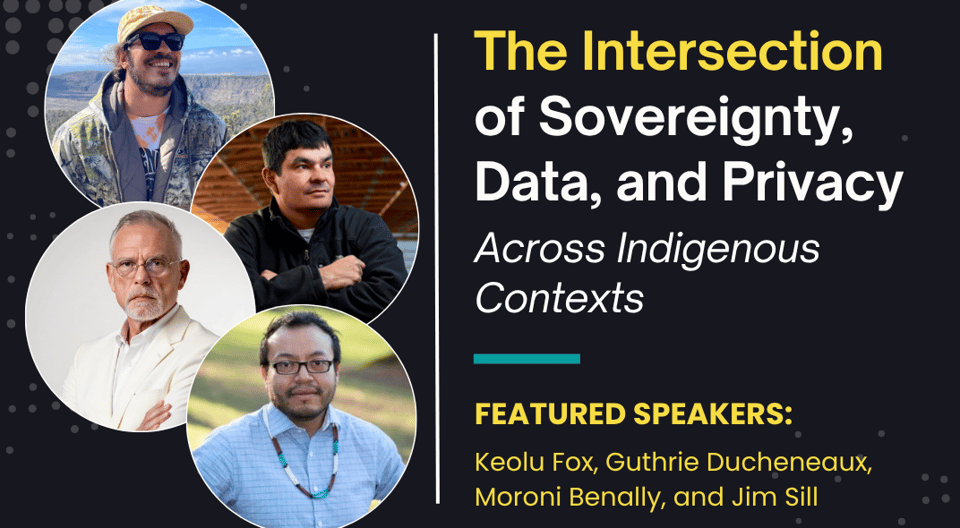
Upcoming Conversation: The October 7th event is titled The Intersection of Sovereignty, Data, and Privacy Across Indigenous Contexts, with panelists that include: a Hawaiian genomicist, a Lakota data security and telecom specialist, a Dine’ public policy expert, and a Cherokee data security and legal consultant.
View the full fall lineup of conversations here.
More curated reads
Remembering the Children: National Day for Truth and Reconciliation
In honour of the sixth annual National Day for Truth and Reconciliation (NDTR), APTN, the National Centre for Truth and Reconciliation, CBC/Radio-Canada and the Algonquin Nation have united to produce a 90-minute multilingual commemorative gathering, entitled Remembering the Children: National Day for Truth and Reconciliation. The live National broadcast will begin at 12pm EDT on September 30, 2026. It can be viewed on APTN and other supporting broadcasters, as well as the National Center for Truth and Reconciliation’s YouTube channel.
The 38,000 testimonies are the largest body of evidence about children’s experiences in these institutions. Journalist Connie Walker and lawyer Kimberly Murray say losing it would mean losing history — both painful and illuminating. “This body of records that has really important information of Survivors … is going to be destroyed,” Connie Walker says. The Pulitzer and Peabody Award-winning investigative journalist and member of Okanese First Nation in Saskatchewan is talking about the 38,000 testimonies from residential school survivors collected by the federal government between 2007 and 2012. They contain first-hand experiences recounted by some of the estimated 150,000 children who attended residential schools operated by the Canadian government. These testimonies are the largest body of residential school records in Canada — an irreplaceable body of evidence, containing more than six times as many testimonies as the Truth and Reconciliation Commission. And in September 2027, it is set to be destroyed.
6 decades of Treaty 8 history repatriated to Dane-zaa people in northern B.C.
Decades of recorded history, ancient songs, and family genealogies have officially returned home to Treaty 8 First Nations in B.C.'s Peace Region. More than 60 years in the making, the Ridington Dane-zaa Archive was repatriated to Treaty 8 First Nations during a ceremony in Fort St. John, B.C., on Friday. The vast trove includes more than 8,000 digital records, including photos, hundreds of hours of audio and video recordings, and textual documents tracing the lineage of family genealogies. Ridington’s daughter, folklorist Amber Ridington, believes the archive is one of the largest collection of ethnographic material about sub-Arctic people in the world. She said the records contains sacred and culturally sensitive knowledge, including accounts of residential schools, displacement, and the colonial impacts of racism and violence. Because the information was scattered across dozens of hard drives and file formats copied over the years, identifying master materials required significant collaboration, she said.
New Guidelines Aim to Protect Indigenous Knowledge in Scholarly Publishing
Who controls Indigenous knowledge when it enters the world of academic publishing and digital data? Levi Rickert sits down with Dr. Lydia Jennings of Dartmouth College to discuss new guidelines for the governance of Indigenous peoples’ data in scholarly publishing. Dr. Jennings is an environmental soil scientist and a citizen of the Pascua Yaqui Tribe (Yoeme) and Huichol (Wixáritari). Jennings helped lead a collaborative effort that brought together Indigenous scholars, allied scholars, journal editors and data and metadata experts to develop the guidelines. The guidelines center on the CARE Principles for Indigenous Data Governance: Collective Benefit, Authority to Control, Responsibility and Ethics. In the conversation, Jennings explains how the principles can be applied throughout the scholarly publishing process, from recognizing Indigenous peoples’ rights and interests in data to strengthening relationships between researchers, publishers and Native nations.
Closing the gap in authentic Indigenous representation in Canadian media
Blueberry Moon is being created as an Indigenous stock media platform, a place where Indigenous creators can sell illustrations, photography, vector graphics, video clips and audio for commercial use. For too long, Indigenous folks haven't been properly represented in mainstream media. Also, for too long, Indigenous artists haven't benefited economically from their own art and stories. For businesses, governments, institutions, non-profits and Indigenous organizations, we want to create a trusted place to purchase media from verified Indigenous creators, with licensing and support built into the platform. But Blueberry Moon is about more than selling media. Education will be an important part of it. If you can donate some of your time and complete or share our survey, it would genuinely help us shape the next phase of Blueberry Moon.
Resources and opportunities

Add a comment: