
First-of-its-kind partnership announced at ALL IN
Pilot empowers community to share its history entirely on its own terms
Boozhoo News River Readers,
🍂Seasonal shifts mean updated graphics on our digital touch points courtesy of our lead designer Tom Spetter.
This week's Big Picture is also about our own Jeff Ward working with his nation Sandy Bay on an exciting partnership with CEIMIA. We look forward to sharing more as the project develops!
As always there are curated articles after our main article, and we’ve begun to highlight a few “resources and opportunities” at the bottom of the newsletter as well. (If you want to share a link in this section, send it on over to news@animikii.com)
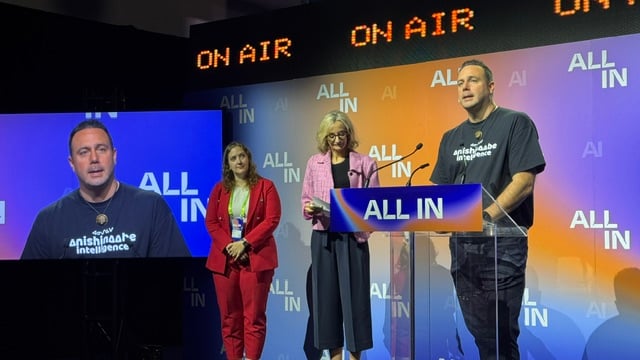
CEIMIA and Animikii Indigenous Technology announce a first-of-its-kind partnership with Sandy Bay Ojibway First Nation
The Big Picture: CEIMIA (the International Centre of Expertise in Montréal on Artificial Intelligence) and Animikii Indigenous Technology are happy to announce on the margins of ALL IN, a new innovative partnership with Sandy Bay Ojibway First Nation. This collaboration marks a first-of-its-kind pilot, testing innovative and responsible methods for the secure stewardship and exchange of Indigenous data.
Why we think it matters: This pilot empowers the community to digitize, protect, and share its history entirely on its own terms. It’s an important step forward for community-led tech and true Indigenous digital sovereignty.
Sandy Bay Ojibway First Nation, an Anishinaabe (Ojibway) community located in Manitoba, will trial CEIMIA’s Roadmap in preparing data about the history of the Community to be made available through digital means, for the benefit of the current Community and for posterity, through technology solutions to be codesigned between Animikii and the Sandy Bay Community.
“Responsible AI and digital innovation cannot exist without trust, sovereignty, and ethical stewardship at their core.” — Sophie Fallaha, Executive Director, CEIMIA
“Sandy Bay Ojibway First Nation is deciding for themselves how our history gets recorded, who can access it, and what future generations will inherit. For me, this is what Indigenous Data Sovereignty looks like in practice and it is exactly why we are building Niiwin. We’re grateful to the Community for trusting us to co-design this work with them, and to CEIMIA for bringing a data sharing roadmap that has been tested with governments and is now being improved and tested by a First Nation on its own terms.”
— Jeff Ward, CEO of Animikii Indigenous Technology, member of Sandy Bay Ojibway First Nation
Read the full announcement from CEIMIA here.
More curated reads
AI is distorting archaeology and flattening Indigenous Knowledge - While artificial intelligence can help archaeologists, it can also spread pseudoscientific claims and false histories, stripping Indigenous knowledge of context, consent and community control. It’s something that can undermine both scientific expertise and Indigenous authority. As researchers, we are increasingly concerned about how these systems scrape and reuse Indigenous Cultural and Intellectual Property (ICIP) without consent. And pseudoarchaeology has a long record of diminishing Indigenous histories. Some of the most remarkable monuments ever built have been credited to almost anyone but the Indigenous peoples who made them.
“Indigenous Knowledges are not inert or ownerless information waiting to be mined. They are relational, situated and governed by protocols.”
GNWT and U of A sign 10-year northern research agreement - The Government of the Northwest Territories and University of Alberta have signed a new research agreement aimed at addressing northern priorities over the next decade. The partnership, which runs until March 2035, will focus on areas including climate change, public health, artificial intelligence, agriculture and social transformation. It will also examine Arctic sovereignty, defence and security, with a focus on northern communities. Research under the agreement is to be Indigenous-led or co-developed with local communities, with data governed according to Indigenous data sovereignty principles.
Indigenous Knowledge and observations improve Arctic Ocean model skill and relevance - Ocean models are increasingly central to understanding and anticipating change in ocean ecosystems. Yet these tools have been developed almost entirely without the people who observe, depend on, and steward these environments. Here we describe a framework for building Arctic Ocean models through sustained, two-way partnerships with Indigenous observers. Working with the Alaska Arctic Observatory and Knowledge Hub, we use seasonal calendars to bring together narrated observations from Iñupiat observers and output from an Arctic Ocean model. These Indigenous observations reveal model deficiencies that evaluation with academic scientific data misses and identify priorities for model development. At the same time, community priorities shape our research questions, from sea ice safety to the oceanographic conditions underlying bowhead whale harvesting success. This approach upholds Indigenous rights, data sovereignty, and self-determination while producing models that are more accurate, locally grounded, and relevant. Although focused on the Arctic, it offers a template for place-based, socially just ocean modeling in other regions.
Big Tech Is Trampling Native Treaty Rights to Build Data Centers - In 2004, Microsoft’s future chief sustainability officer, Melanie Nakagawa, co-edited a law journal issue on Indigenous peoples’ right to prior informed consent. This month, as a data center developer routed around exactly that standard in New Mexico, she didn’t answer whether it applies to her own company’s work. Ask Google, Amazon, and Microsoft whether they consult Native nations before building a data center, and you’ll get the same answer: silence dressed up as sustainability commitment — as if the law here were unsettled, rather than two centuries old. Chief sustainability officers operate by ESG (environment, sustainability, governance) principles that imply tribal consultation, typically executed either to pacify objecting community members or to comply with an environmental review process. ESG reports are meant to define a company’s community impact but instead serve as shields for deals structured to sidestep responsibility.
CEIMIA, Animikii partner with Manitoba First Nation on stewardship of Indigenous data - Animikii Indigenous Technology, alongside the International Centre of Expertise in Montréal on Artificial Intelligence (CEIMIA), announced the creation of what it’s calling a “first-of-its-kind” partnership between Animikii, CEIMIA, and the Sandy Bay Ojibway First Nation (SBOFN). The partnership will bring the three parties together for a pilot project exploring methods of “securing stewardship and exchange of Indigenous data.”
Resources and opportunities
Learn it: Technology-facilitated violence increasingly linked to digitalisation
Bookmark it: The model AI governance should aspire to: systems that strengthen human capability rather than replace it.
Attend it: Indigenous Data Sovereignty: Foundations for Researchers - Virtual - University of Guelph
Deeper read: What new data reveals about missing and trafficked Indigenous persons in Canada and the US

Add a comment: