
Indigenous Veterans Monument goes digital
Accessible format reaches new audiences
Boozhoo News River Readers,
This week’s news includes digital heritage projects, investments in media, and an article on data infrastructure.
The curated articles follow our feature story, and we’ve begun to highlight a few “resources and opportunities” at the bottom of the newsletter as well.
If you want to share a link in this section, send it on over to news@animikii.com!
The frameworks are working.
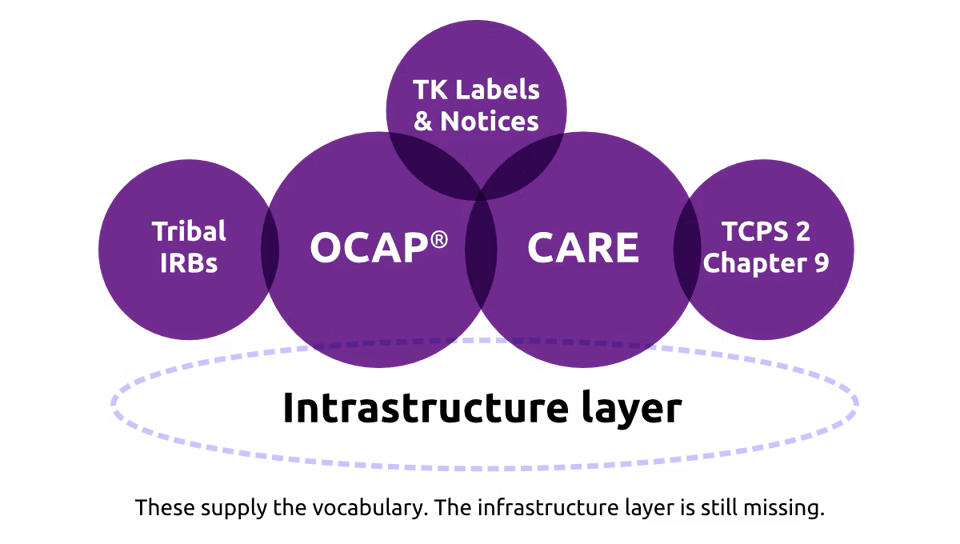
The Big Picture: First Nations set out OCAP®: ownership, control, access, possession. CARE added collective benefit, authority to control, responsibility and ethics. These frameworks are the vocabulary researchers and communities now share to assert authority over data. What the frameworks do not supply is the underlying data infrastructure to exercise that authority during the active years of a project: a governed home for the whole dataset, held by the community, while the analysis is still running.
Why we think it matters: Our technology is now ready to support those ethical frameworks at the practical infrastructure layer. Our new article is about that data layer.
Read more here: Indigenous data sovereignty and research: the infrastructure question beneath good ethics
More curated reads
A team of students in Creative Technologies and Design (CTCH & DES) at the University of Regina are using digital storytelling and emerging technologies to bring the Saskatchewan Indigenous Veterans Monument in Victoria Park to audiences around the world through an interactive website called Living Honour. The website features a 360-degree recreation of the monument alongside historical content, video interviews, and educational resources that honour Indigenous veterans. By sharing these stories in a dynamic and accessible format, the project helps connect new audiences, including youth and people in remote communities, with the significant contributions Indigenous veterans have made to Canada's military history. The project was developed by the Royal United Services Institute (RUSI) Regina in partnership with the U of R's Faculty of Media, Art, and Performance (MAP) and sponsored by the Saskatchewan Indigenous Veterans Monument Committee (SIVMC).
CMF welcomes Government of Canada’s historic investment
The Canada Media Fund (CMF) welcomes the Government of Canada’s historic investment of $213.4M in the CMF, announced today by the Honourable Marc Miller, Minister of Canadian Identity and Culture. We also applaud the funding allocated to our partners across the audiovisual sector, namely Telefilm Canada, the Indigenous Screen Office, and independent funds administered by the Department of Canadian Heritage, who all play essential roles in a strong and sustainable Canadian screen sector. This sum is part of the $600M federal commitment to Canada’s audio and audiovisual sectors announced in June by the minister and confirmed last Thursday in Budget 2026.
For Dr. Wendsler Nosie Sr., the fight to protect Mother Earth is inseparable from the fight to preserve the identity, traditions, and future of Indigenous peoples. As founder and leader of Apache Stronghold, Nosie has spent years defending Oak Flat, a sacred Apache site in Arizona threatened by copper mining. His understanding of natural law is rooted in the belief that the Earth is a living mother who sustains all of creation, rather than a resource for human exploitation. As artificial intelligence and emerging technologies transform the world, his message raises an urgent question: How can humanity embrace innovation without losing sight of its responsibility to protect what is sacred? This intersection of Indigenous sovereignty, cultural preservation, and technological change was at the heart of the North American Indigenous Digital Sovereignty Summit, held October 2–3, 2026, at Notre Dame Law School.
Creating room for Indigenous researchers to grow
At ASU, Indigenous professors nurture the next generation of scientists by helping Native students bring community knowledge and responsibility into their work. Ava Schaaf can picture the future she wants: medical school, a physician’s degree and another Native doctor for her community. Getting there means working through difficult science courses. It also means finding people who help her believe she belongs. At Arizona State University, she found one of those people in Krystal Tsosie, an assistant professor in the School of Life Sciences. A Navajo Nation member, geneticist and bioethicist, Tsosie helps students recognize the scientific thinking within knowledge passed through their families and communities. Tsosie teaches that Indigenous knowledge and laboratory science share practices of observation, testing and adaptation. She also asks students to consider power; whose questions receive support, whose knowledge gets recognized and who benefits from the results. That teaching comes with humility. A doctorate in a narrow specialty, she said, cannot be presumed equivalent to an elder’s lifetime of knowledge.
Resources and opportunities
Deeper dive: Indigenous data sovereignty—A new take on an old theme
Attend it: Taking Back AI Governance
Learn it: Arctic Peoples and Cultures

Add a comment: