
What will AI infrastructure mean for energy, the environment and communities?
Generative AI may be a digital product, but it’s built on vast physical infrastructure.
Boozhoo News River Readers,
This week we’ve got stories about mapping belonging, data relationships in the space sector, and beadwork intervention with child welfare records.
If you’re in the lower mainland of BC you may want to attend Jeff Ward’s appearance live and in person at SFU, but livestream registration means you don’t have to miss out - read more below!
P.S. - Animikii turns 23 this week on Nov 5th 🥳 We’re looking back on what we've built together - from being Canada's first Indigenous B Corp to the incredible evolution of Niiwin, our database tool for organizations holding community data.
We’re thankful to all the partners and communities who've been integral to our shared success. Chi Miigwech!
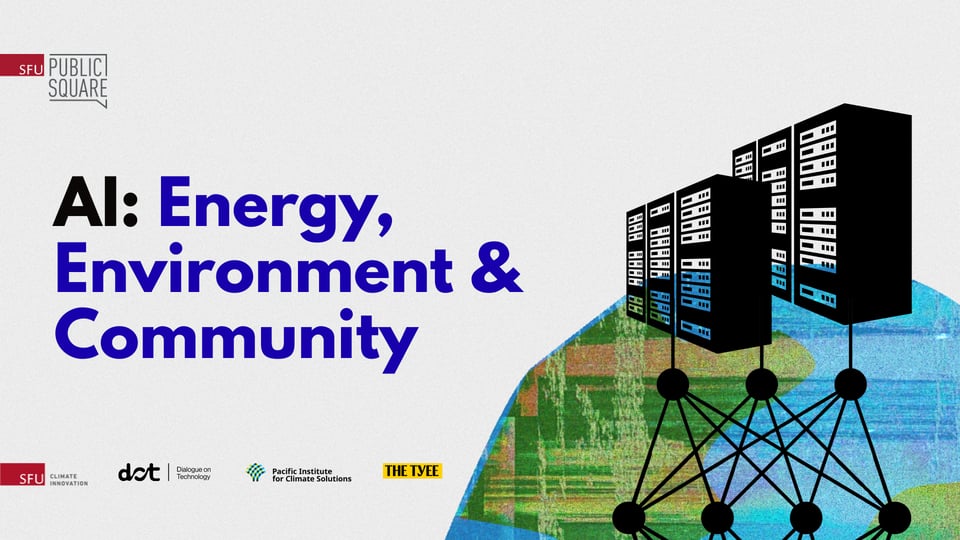
Join Paris Marx, Sean Mullin, Kate Harland, Jeff Ward and Isaac Phan Nay for a public panel on Canada’s AI data centre buildout.
The Big Picture: Across Canada, AI data centres are being planned and built rapidly, bringing potential economic opportunities alongside important questions about electricity demand, water use, climate impacts and community decision-making.
Why we think it matters: Leading Canadian experts will gather on Nov 19th for “AI: Energy, Environment & Community,” a timely panel conversation examining the environmental, economic and social implications of Canada’s expanding AI infrastructure. They’ll discuss what a data centre buildout could mean for Canada’s environment, as well as what options local and national leaders have to regulate this new industry. They’ll also dig into the growing opposition in communities where companies are seeking approval to build.
You’re invited: Co-presented by The Tyee, SFU Climate Innovation, the Dialogue on Technology Project, and the Pacific Institute for Climate Solutions (PICS), the panel will examine the impacts and opportunities of AI data centre expansion in Canada and ask what conditions, if any, will determine social licence to operate. A moderated audience Q&A will follow.
Free livestream tickets available: November 19, 2026 | In Person Tickets from $5.00 | Doors 6:30 pm | Event 7:00-8:30 pm | The Djavad Mowafaghian Cinema, SFU Goldcorp Centre for the Arts
More curated reads
Research data are attached to a context and people, and the open data practice needs to address the social dimensions of data, which the FAIR principles overlook, and the CARE principles address. The first cross-national Sámi Science Week (2025) hosted two panels, where Sámi research data governance was addressed. This commentary summarises the panels, that is, the concerns raised with open data and solutions for how to apply this for Sápmi. Key themes that emerged from the panels were the need for Sámi-specific governance principles, the development of Sámi-specific governance protocols, and the use of Sámi AI to support language revitalisation and culturally sensitive healthcare tools. However, concerns were raised about the risks of data misuse when data is outside Sámi control and management—in particular, in the recent data-driven technological advancements.
FLAIR project at SFU harnesses AI to revive Indigenous languages
A new project hosted at Simon Fraser University (SFU) is helping Indigenous communities train a new generation of speakers and support them with technologies including artificial intelligence (AI). First Languages AI Reality (FLAIR), housed at SFU’s Digital Democracies Institute (DDI) and Cedar Supercomputing Centre, is developing AI-powered learning modules for at-risk languages and training AI models on them to help more people learn languages that are in danger of disappearing. The project, led by Indigenous scientists Caroline and Michael Running Wolf, is currently working with four Indigenous communities: the Gwich’in in Northwest Territories, Kwakwaka’wakw on Vancouver Island, the Makah Tribe in Washington State and the Yawanawá of the western Brazilian Amazon. “Our big dream is that all across the Americas, and the world, Indigenous languages are thriving ... they are in people’s hearts and minds and in daily use and are alive and well." - FLAIR co-founder Caroline Running Wolf.
Governing Our Data on Our Own Terms
How one urban Indigenous organization is working to transform data governance using a model that’s founded on Indigenous values. For years, nearly every piece of data the Tucson Indian Center (TIC) collected was designed to answer someone else’s questions. Since 1963, TIC has served the urban Native community in Tucson, Arizona, offering primary care and behavioral health services, diabetes prevention and wellness programs, employment and job training, and emergency housing assistance. Intake forms for those programs, satisfaction surveys, and reporting metrics were all developed to collect data that met federal grant requirements but told us almost nothing about what our community wanted to know about itself. Eventually, those of us leading and working at TIC said, “Enough.” We began building a different kind of data system—one organized around our community’s priorities. But to understand why this work is both difficult and transformative requires understanding the origins of contemporary data systems that are used to quantify Native people in the United States.
Mapping Belonging: How Indigenous Communities Use Maps to Defend Their Rights
In this essay, report coauthor Aliya Ryan reflects on the power of community mapping to communicate Indigenous relationships to land and support legal strategies for territorial defense. The report not only showcases the diverse purposes for which maps can be used in legal cases, but also delves into the how. How can communities carry out mapping and data collection in ways that support their use as evidence in court? Drawing on experiences from the field, the report explores how to choose appropriate technologies for a community's needs, document Indigenous place names to demonstrate historical connections to territory, use printed maps and expert witnesses in court, and keep people and data safe when collecting sensitive information.
Indigenous data sovereignty and the East Coast space sector
How could the East Coast space sector support Indigenous data sovereignty, and what would we need to establish to know whether it does? This overview develops that question through a sequence of more specific inquiries. A short regional timeline establishes the setting. Indigenous governance sources then help distinguish authority over data from the provision of infrastructure or information. The discussion asks who can define relevant requirements, where a space-sector organization enters a data relationship, and what evidence could demonstrate support. One account of Inuit-led sea-ice mapping provides a concrete reference for asking about purpose, interpretation, and access. The paper then identifies questions that public documents leave unresolved and proposes a way to refine and investigate them through appropriate Indigenous processes, documents, and interviews.
Resources and opportunities

Add a comment: