
“Records have a spirit and need to be treated with respect”
On the road with Niiwin at IHHG 2026, and exploring Indigenous rights reshaping archaeology in Canada

Boozhoo News River Readers,
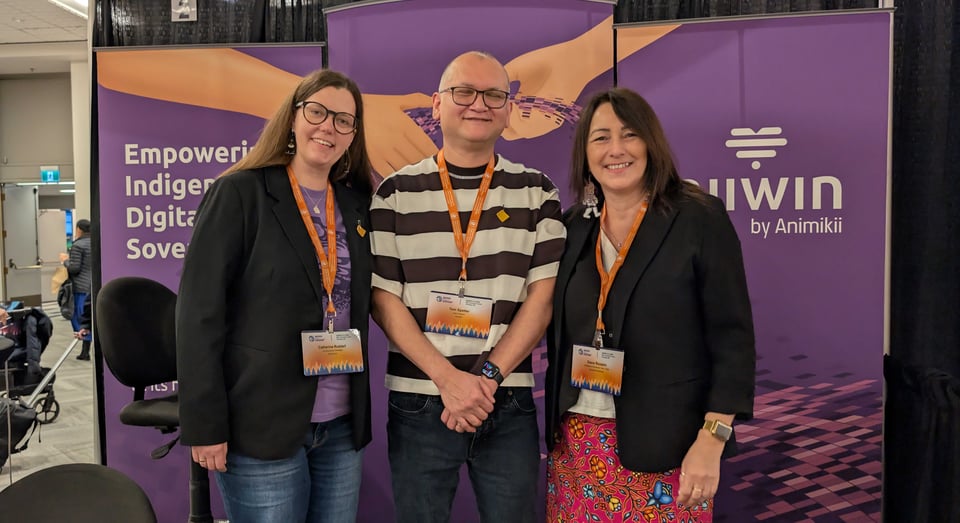
We’re on the road this week talking to community members and giving live demos of our new data platform Niiwin!
Read more below - today we’re heading straight to the news!
This week’s stories include:
A quick note from Treaty 1 Territory - we’re at IHHG this week!
The big picture: The National Centre for Truth and Reconciliation (NCTR) and the First Nations Confederacy of Cultural Education Centres (FNCCEC) are hosting the Indigenous History and Heritage Gathering (IHHG) in Treaty 1 Territory this week. This gathering is one of the many important events held during Indigenous History Month, bringing together diverse groups who are working to amplify the distinct stories of Indigenous Peoples across Turtle Island.
Why it matters: 2025 marked a decade since the Truth and Reconciliation Commission presented the 94 Calls to Action, setting a foundation for reconciliation between Canadians and Indigenous Peoples. IHHG serves as an essential space to reflect on the progress made since June 2015, and provide an opportunity to engage in meaningful dialogue, explore shared histories, and commit to building a better future rooted in respect, understanding, and reconciliation.
What we’re hearing so far:
“There was never a coherent records management keeping system in place, across institutions, churches, provincial and federal offices… The TRC consulted over 150 repositories and archives over the course of their work” - Raymond Frogner, Head of Archives/Senior Director of Research, National Centre for Truth and Reconciliation.
“Records have a spirit and need to be treated with respect” - Dr. Stephanie Sinclair, of the First Nations Health and Social Secretariat of Manitoba.
"Building capacity within your nation is one of the most important things you can do to keep your information sovereign" - Skylee-Storm Hogan-Stacey, Senior Research Officer, Critical Data Studies, First Nations Information Governance Centre (FNIGC)
This work is personal to us at Animikii. It's the same reason we built Niiwin: so communities can own and share their stories on their own terms.
See the full IHHG program here: https://ihhg.ca/
Curated Articles:
Why Indigenous rights are reshaping archaeology in Canada
Archaeological practice is transforming in Canada to recognize Indigenous rights to and governance over cultural heritage. Dr. Kisha Supernant, Director at the Institute of Prairie and Indigenous Archaeology, tells us more. Archaeology in Canada is at a critical juncture. Once treated primarily as a technical discipline concerned with documenting and interpreting the material traces of the past, archaeology is now increasingly recognized as a site where Indigenous rights, governance, and cultural heritage are actively negotiated. For much of its history, archaeology functioned as a colonial practice: Indigenous ancestors were removed from the ground, cultural knowledge was extracted, and interpretations were produced without Indigenous consent or involvement. These actions were often justified in the name of science or heritage protection, but they also contributed to the ongoing denial of Indigenous rights. Over the past several decades, archaeology in Canada has been transforming. There is growing recognition that Indigenous peoples hold inherent rights to their cultural heritage, including archaeological sites, ancestral remains, cultural materials, knowledge, and data.
Indigenous Peoples Push Back as Data Centers Expand Across North America
From the boreal forests of northern Alberta to the deserts of West Texas, Indigenous peoples are pushing back against a wave of data center proposals across Turtle Island, arguing that the booming digital-infrastructure build-out threatens sacred lands, water resources, traditional knowledge and treaty rights. In northern Alberta, the Sturgeon Lake Cree Nation has openly challenged “Wonder Valley,” a proposed multibillion-dollar data center and industrial park that overlaps territory covered by Treaty 8. According to Sturgeon Lake Chief Sheldon Sunshine, the required consultation with the nation was non-existent. “There has been no consultation. The way they act and talk; it’s as if our land and water is there for the taking, and we are expected to get in line to receive the so-called economic benefits,” he said. “Our people are here to remind [Kevin] O’Leary and the Greenview of the international treaty, Treaty No.8, that allows us all to share this land. There is protocol. There are legal requirements. They are not being followed.”
A local Indigenous tech company is making waves in the tech industry
A local Indigenous tech company is making waves in the tech industry, all while helping to ensure Indigenous Peoples are at the forefront of A.I. CyberCloud-AI is an Indigenous tech company based in Calgary that presents Canada’s first Indigenous-led Sovereign A.I. data centres, which are built on Indigenous lands in partnership with First Nations and Indigenous people around the world, and have the possibility of future expansion to data centre manufacturing. The three co-founders of CyberCloud-AI are Daniel Mistaken Chief, Dr. Teena Starlight, and Josephine Naicker. According to Daniel Mistaken Chief, their company started as something else, when they met at a powwow.
After more than three years of work, Library and Archives Canada (LAC) is wrapping up its Day Schools Project this March. This week on InFocus, LAC senior project manager Beth Greenhorn gives us a behind-the-scenes look at the labour of digitizing millions of Indian Day School records. ”What the team has been doing over the last couple of years has been flagging records that are relevant to either Day Schools or other related educational institutions,” Greenhorn said on InFocus. “Through the funding that we received through the Treasury Board, we were able to digitize up to six million records.” Between the 1860s and 2000, Canada operated 699 Indian Day Schools across the country. An estimated 200,000 children attended them. The intention was to assimilate Indigenous children into settler Canadian society, stripping them of their cultural practices, knowledge and identity. Unlike residential schools, students were allowed to return home at the end of the day. However, there was still widespread abuse and neglect. LAC has been digitizing records through the Day Schools Project since 2022. By enhancing file-level descriptions, Greenhorn said it will now be easier for survivors and researchers to retrace the past.
We’re grateful to have our headquarters on traditional territory of the Lək̓ʷəŋən (Lkwungen, Songhees and Esquimalt) Peoples of the Coast Salish Nation.
Animikii Inc: theDock Centre for Social Impact 100-722 Cormorant St Victoria, BC V8W 1P8
You're receiving this because you signed up for the Animikii News River. You can unsubscribe at any time.

Add a comment: