
Matriarch earning PhD's & communities protecting data
Stories on data archives, trusts, centres and systems!
Boozhoo News River Readers,
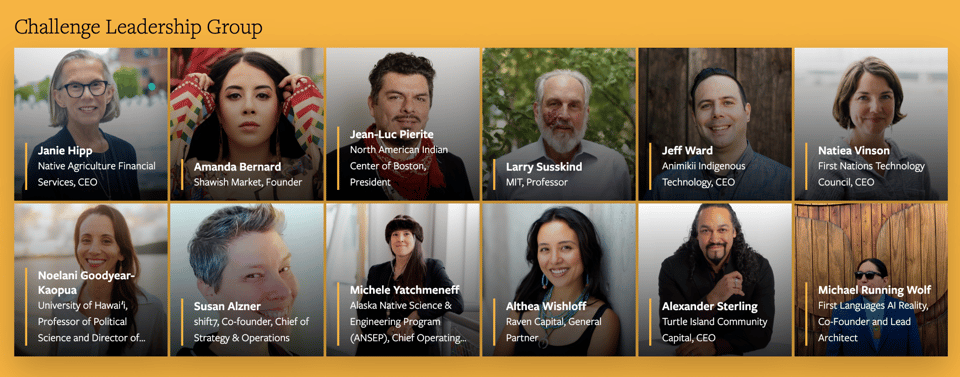
We’ll cut straight to the chase today - with more info about MIT Solve’s Indigenous Communities Fellowship (our very own Jeff Ward has been part of the Challenge Leadership Group for a number of years!)
Following that are stories about community-led health data archives, research linking scattered Indian boarding school records, and a First Nation community using a data centre to preserve its heritage.
2027 Indigenous Communities Fellowship Application Clinic
Each year, the Indigenous Communities Fellowship selects 6-8 innovators who are using traditional knowledge and technology to drive positive impact in Indigenous communities anywhere in the United States and Canada, including territories.
Register now to learn more about the Indigenous Communities Fellowship at MIT Solve and ask any questions you may have about the application process. This session will be recorded and posted on this same webpage.
The Fellowship provides a nine-month program of support that includes funding, a comprehensive resource needs assessment, technical & business mentorship, tailored connections to a network of companies, foundations, and NGOs, and more. At the center of the Fellowship is a peer community of practice, celebrating and supporting Indigenous brilliance, resilience, and ingenuity.
The 2027 Fellowship application is open from September 22 to November 6, 2026, 12:00 pm ET. You can continue to edit and work on your application anytime before the deadline. To help you prepare, download a PDF version of the application here. The PDF version is only for reference; you must submit your application online here.
More curated reads
Indigenous community health studied and turned into data archive
Sturgeon Lake First Nation is making huge steps in the data sovereignty field, with their new projects organized and run by the Lloyd Johnson Memorial Healing Lodge, which is set to host the Miyo-Pimatisiwin Conference next week. “We received all these things, we put them into our own digital archive, and then we’re making it user friendly so that our locals can come and look at their own records and make use of them however they wish,” said Lily Naytowhow, who works at the Healing Lodge in Sturgeon Lake First Nation, who has been one of the main organizers alongside Willie Ermine. “They can learn about who their family is, they can learn about what our people used to eat pre-colonial times, they can learn about what the community was like before it changed into a digital society because we live much differently than we did back then.”
Theresa Rocha Beardall Receives William T. Grant Scholars Award
Theresa Rocha Beardall, associate professor of sociology, was named a William T. Grant Scholar, one of seven researchers nationwide selected for the program this year. The award supports promising early-career researchers as they expand their expertise into new disciplines, methods, or content areas. Each William T. Grant Scholar receives $425,000 over five years. With the Grant Scholars award, Rocha Beardall will reconstruct the histories of Native children affected by federal Indian boarding schools in Washington State by locating, digitizing, and linking records scattered across archives, with UW student researchers helping retrieve and catalog those materials. She will work under the direction of the Puyallup Tribal Historic Preservation Department, supporting tribally governed research and curriculum development while developing new expertise in Indigenous data sovereignty and supervised machine learning.
At 73, Mary McDonald is first graduate of McGill’s Indigenous Language Revitalization PhD program
When Mary Tekahawáhkwen McDonald, who also goes by Wá:ri, accepted her PhD at McGill’s Fall Convocation on Oct. 19, she became the first graduate of McGill’s Ad Hoc PhD program in Indigenous Language Revitalization, a program based in the Faculty of Arts Institute for Indigenous Research and Knowledges (FAIIRK). Wá:ri’s lifetime of teaching shaped a dissertation that examines the language from the perspective of someone who grew up speaking it. “She has an ability to take this linguistically informed work and make it accessible in a way that only somebody who has been teaching the language for decades can,” Coon said. The dissertation examines grammatical patterns and kinship terms shaped by Kanien’kéha’s matrilineal structure. “Our kinship system reflects a matrilineal society. The mother’s side of the family carries more weight than the father’s side, and that is reflected in our language,” said Wá:ri.
A First Nation community is using a data centre to preserve its heritage
The Wiikwemkoong Unceded Territory in rural Ontario installed a small data centre as it modernized its recordkeeping systems. Among the digital files it holds are video recordings of Anishinaabe speaking their native language. “Our language is one of the biggest things that most First Nations across the country are losing,” said Wiikwemkoong Chief Tim Ominika. “We will have our knowledge keepers, our language speakers who may be moving on to the spirit world, but their legacy is still going to be protected for many years to come by having our own data systems in place and protecting that.” The idea of digital sovereignty has gained momentum in places like Europe, where leaders are wary of the widespread influence of American Big Tech. For the Wiikwemkoong and other Indigenous communities, it is also about asserting authority over their own information after historically being excluded from its collection and use by colonizers.
Data centres: Opposing them and developing them are not the only two choices
When a nurse in Thunder Bay opens a patient’s chart or a shopper in Halifax taps a bank card, the request travels somewhere physical — a building humming with servers, storage, network equipment, backup power and cooling systems. Data centres are not mythical “AI factories” or innocuous warehouses, but industrial infrastructure with real appetites for electricity, water and land. Current debate about data centres seems to offer a false binary: stop these facilities or accept them unconditionally. There is a better option. We need to develop projects that are transparent, low-carbon, grid-responsible, respectful of Indigenous rights and that leave durable public value where they stand.
Indigenous Peoples’ Digital Data and Artificial Intelligence
Indigenous peoples have been able to define the scope of their territory, which extends beyond the places they inhabit to include forests, water, land, biodiversity, and the radio waves. However, today the concept of territory has taken on new dimensions with the advent of so-called Artificial Intelligence (AI), which involves digital data. The Avispa Mídia team interviewed the civil society organization Servicios Universitarios y Redes de Conocimiento en Oaxaca (SURCO), which has spoken out on this issue, arguing that the magnitude of the problem is no longer limited to the “protection of personal data” but also encompasses collective data. First and foremost, the organization makes a clear distinction between “community data” or “communal data,” which refers to collective information generated by and about Indigenous communities, conceived as a common good and communal territory within a framework of autonomy and self-determination.
Resources and opportunities

Add a comment: