
Local Contexts speaking at #DataBackDay
Join us to explore Indigenous data sovereignty, also catch up on this weeks Indigenous tech news!

Boozhoo News River Readers,
We are just days away from our virtual event - #DataBack Day - THIS Friday!
We have our final speaker announcement below, read more about our guests from Local Contexts, and also find the link to register - it’s free ;)
Forward this email to a friend or colleague who might be interested.
Thanks for reading! Here’s the news,
This week’s stories include:
Understanding artificial intelligence through indigenous relational ways of knowing.
Professor Krystal Tsosie Advocates for Indigenous-Led Science at AAAS Conference
Indigenous communities partner with NAIT to create “living” atlases
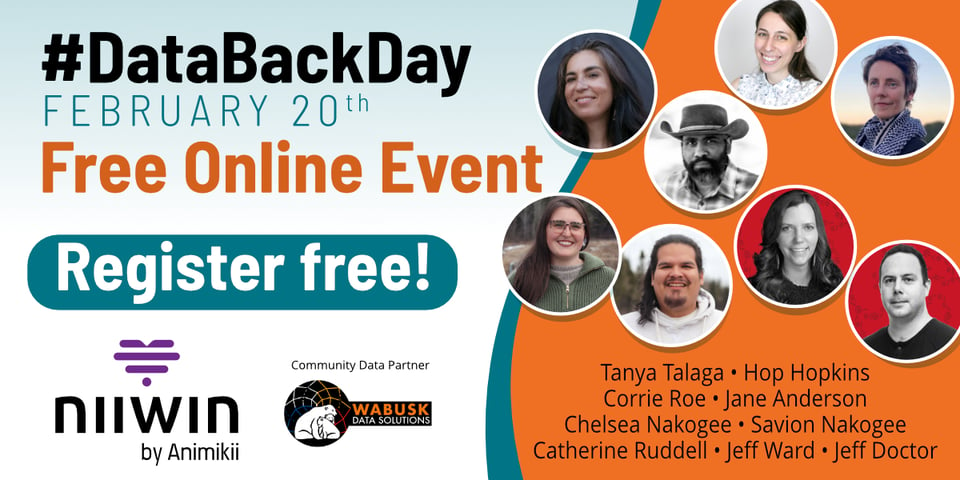
Announcing Local Contexts at this week’s #DataBack Day event!
The big picture: The Local Contexts team is presenting at our free online event on Friday, February 20th! Local Contexts is a global initiative that supports Indigenous communities with tools that can reassert cultural authority in heritage collections and data by focusing on Indigenous Cultural and Intellectual Property and Indigenous Data Sovereignty.
Why it matters: They created the Traditional Knowledge and Biocultural Labels, digital tools used in 34 countries to help Indigenous communities control how their cultural heritage and data gets accessed and shared. Over 250 museums, libraries, and repositories use the labels, including the Library of Congress.
Key points:
Hop Hopkins, Corrie Roe and Jane Anderson will be speaking.
Their work supports Indigenous communities to repatriate knowledge and gain control over how data is collected, managed, displayed, accessed, and used in the future.
Other speakers for #DataBack Day include Animikii’s Jeff Ward, Jeff Doctor, and emcee Catherine Ruddell, Chelsea Nakogee and Savion Nakogee from Wabusk Data Solutions, as well as keynote speaker Tanya Talaga.
Learn more: We can't wait for this conversation. Free registration: https://niiwin.app/databack-day
Curated Articles:
Professor Krystal Tsosie Advocates for Indigenous-Led Science at AAAS Conference
Krystal Tsosie, a leading figure in Indigenous genomics, bioethics, and data governance, is set to present a landmark lecture titled The Future of Science Is Indigenous at the esteemed American Association for the Advancement of Science (AAAS) Annual Meeting. This gathering, recognized as one of the largest multidisciplinary science conferences worldwide, serves as a pivotal platform for shaping discourse on the ethical oversight and governance of emergent scientific technologies. Tsosie’s discourse promises to illuminate the critical contributions Indigenous science provides to the construction of equitable, accountable, and sustainable frameworks amidst the accelerating evolution of genomics, artificial intelligence (AI), and precision health. Central to Tsosie’s thesis is the application of Indigenous science not simply as a cultural lens but as a robust, time-tested governance architecture. Indigenous knowledge systems, honed through centuries of environmental and social collaboration, offer models of decision-making characterized by communal responsibility, sustainability, and long-term foresight.
Gender & Tech: Digital Transformation
The Gender & Tech Online Talk Series brings together leading scholars, advocates, and practitioners to discuss the intersections of gender, technology, democracy and human rights. It critically examines how digital platforms and technologies impact women, queer and gender-diverse individuals while exploring pathways for more inclusive, rights-focused digital governance frameworks. This session explores the concept of “digital transformation”: its meanings, purposes, promises, and failures. From infrastructure to community engagement, the speakers will discuss the conflicts between public goods and private interests in the development and deployment of technologies from critical non-Western and Global Majority perspectives. About the panelists: Madeleine Redfern from Iqaluit, Nunavut is an Indigenous woman involved in high-tech and innovation. Actively involved in transformative technologies in telecommunications, transportation and energy. Jamila Venturini is co-executive director of Derechos Digitales, a Latin American-based non-profit organization which defends and promotes human rights in digital environments since 2005. Yasmin Curzi is a postdoctoral research fellow at UVA’s Digital Technology for Democracy Lab. Her areas of interest and expertise span human rights law, digital law, gender studies, and digital sociology. This session will be recorded; register to ensure you are notified when the recording is available to view.
Highlighting Indigenous Research at Queen’s: Voices of Indigenous Research Column
Michael G. Sherbert: Understanding artificial intelligence through indigenous relational ways of knowing. Michael G. Sherbert is a postdoctoral fellow at Queen’s University whose research repositions Artificial Intelligence (AI) through Indigenous relational epistemologies. Across his work in AI, religion and culture, technology, disability, and Indigenous thought, he argues that AI isn’t a neutral technology. Rather, it reflects an underlying ideology that shapes ideas about humanity, progress, ethics, power, and the future. For Dr. Sherbert, his work is both scholarly and deeply personal. As an Algonquin researcher, a parent of autistic and neurodivergent children, and someone connected to disability communities, questions of embodiment, sovereignty, and futurity are lived realities. Looking ahead, he continues to develop both theoretical and community-based research on Indigenous AI governance and the ethics of enhancement-driven narratives. He’s especially interested in how Indigenous futurisms can offer meaningful alternatives to dominant Western techno-utopian visions. His work ultimately calls for technological futures grounded less in mastery and efficiency, and more in care, accountability, and the courage to recognize that not everything should be computed.
Indigenous communities partner with NAIT to create “living” atlases
In a box in NAIT’s Data Visualization Lab – a space with a “mission control” vibe, featuring video screens, projectors, touch-tables and powerful computers – is a collection of obsolete tech from bygone eras. “I've got this informal scavenger hunt going on with folks,” says Dave Blaine of his colleagues in applied research and elsewhere at the polytechnic. “Anytime they find a legacy data-reader, they bring it to me.” Given the preciousness of the information Blaine works with as a geographic information system (GIS) analyst, that pile of old disk drives and media players is arguably as important as anything else in the lab. While much of the data available to him is current, some dates back decades. It includes maps, GIS data, vegetation studies, mining impact reports, and even audio recordings, all from traditional territories of Indigenous communities. Since January 2022, Blaine has migrated such data to web-based platforms known as Indigenous-led community atlases. They’re “living” maps, depictions of information across time and space that evolve with the addition of data representing physical, biological, cultural and other changes to the landscape. “What [this] has enabled us to do is give a voice to our data, and give us control over that voice, and how it’s handled and managed,” says Zachary Gauchier, Peavine’s first resident IT tech. “For my community, this is the first step toward data sovereignty.”
Using Your Tribal Data to Chart Your Future
How tribes can participate in the Survey of Native Nations. The Survey of Native Nations represents a transformative approach to advancing the quality and availability of tribal financial data to inform tribal decision-making. Working with the Center for Indian Country Development (CICD), tribes that have completed the survey are enhancing their ability to analyze their financial data and communicate their economic contributions in data-informed ways. Built on Indigenous research principles of tribal data sovereignty and reciprocity, the Survey of Native Nations leverages the Federal Reserve System’s secure data infrastructure to protect and steward tribal data. This webinar will provide tribal leaders, tribal finance practitioners, tribal government services staff, and Native organization leaders with the opportunity to learn how tribes are leveraging this unique data collaboration to advance their data practices.
We’re grateful to have our headquarters on traditional territory of the Lək̓ʷəŋən (Lkwungen, Songhees and Esquimalt) Peoples of the Coast Salish Nation.
You're receiving this because you signed up for the Animikii News River. You can unsubscribe at any time.

Add a comment: