
Announcing #DataBack Day Keynote Speaker!
Stories of family and community data research with national bestselling author Tanya Talaga
Boozhoo News River Readers,
We have exciting news to share today - our speaker line up for #DataBack Day is now LIVE!
We’re welcoming Tanya Talaga as the keynote for this virtual event on Feb 20 👏
For anyone doing data reclamation work in their own community, she’ll be sharing her approach as chronicled in her national bestselling book The Knowing, offering a powerful example of how community is at the heart of this work.
We’re also welcoming our community data partners - the great folks at Wabusk Data Solutions!
Registration is open: niiwin.app/databack-day
Thanks for reading News River, and as always - here’s the rest of the news,
This week’s stories include:
Proactive Solutions in Implementing Tribal Digital Sovereignty
What Past Atrocities Teach Us about Residential School Burials
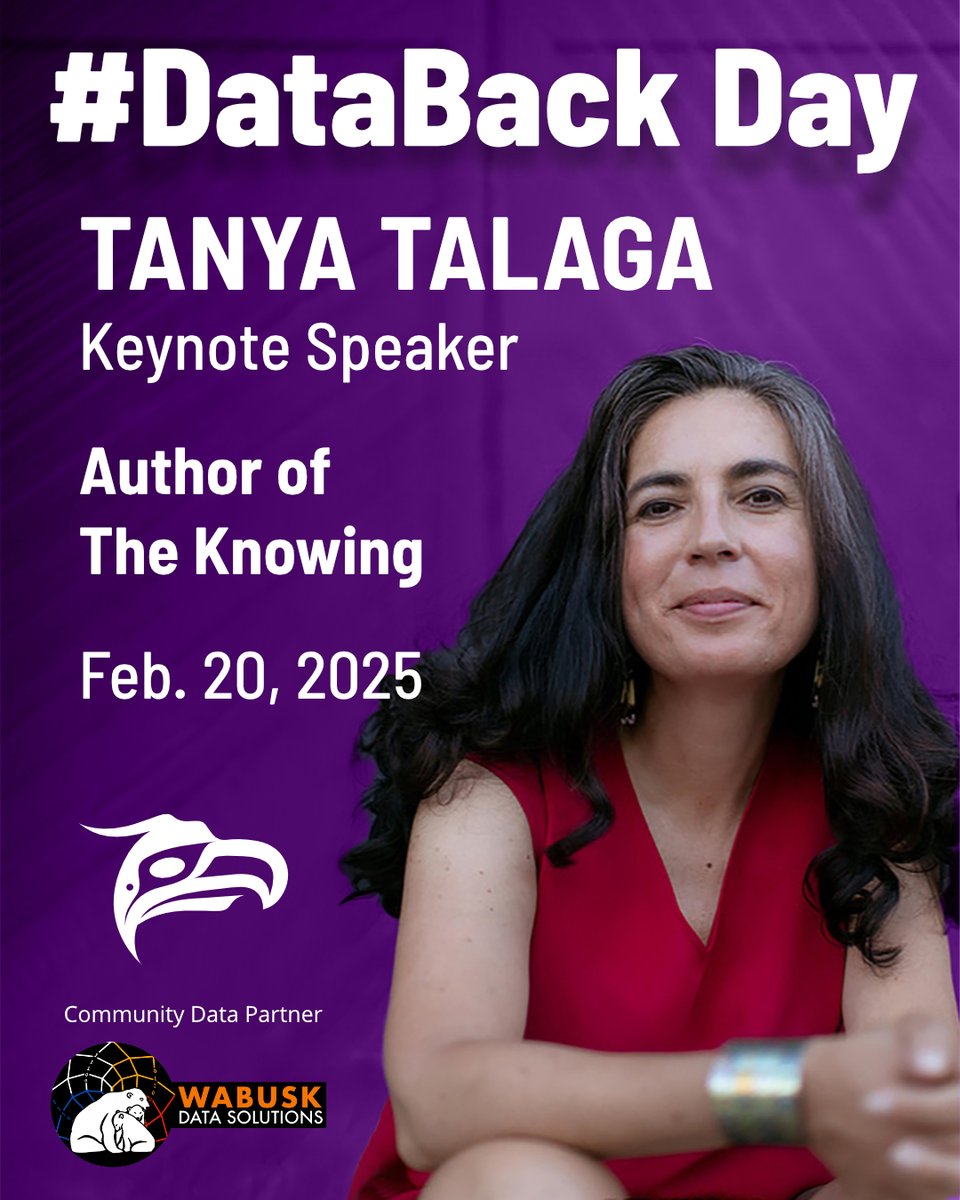
Join Us for #DataBack Day on February 20, 2025
The big picture: Niiwin is hosting a free virtual gathering of conversation, learning, and connection with leading voices in Indigenous data sovereignty, and we’re welcoming Indigenous organizations, academics and anyone who holds Indigenous data.
Why it matters: Data sovereignty isn't abstract. It's about communities deciding who accesses their information, how it's used, and who benefits. It's about building systems that reflect Indigenous governance rather than replacing it. Jeff Ward opens the day by framing what #DataBack means in the context of our work at Animikii and on Niiwin, and why this moment matters for Indigenous data sovereignty.
Key points:
Animikii Impact Strategist Jeff Doctor will take a deeper look at the vision behind Indigenous-led data governance and what it looks like when communities control their own information and why that control is foundational to self-determination..
Chelsea Nakogee and Savion Nakogee from Wabusk Data Solutions will be sharing real stories from community data work: what it takes to build data capacity in a Nation, the challenges that come up, and what changes when communities lead the process.
Tanya Talaga will be delivering the keynote, drawing from her national bestselling book The Knowing and documentary. Talking about the family stories and folder of documents that fueled her search in archives, government records, and community sources, her approach offers a powerful example of how community is at the heart of this work.
What they’re saying: “As a journalist it fell to me to go and find these records and… I’ve been doing this for over 20 years but I needed an army of help because it was so complex in just trying to untangle, where are these records? I did have a lot of archivists and researchers help me… and this is what they do. Imagine if you are a regular person, how do you start?” Tanya Talaga, about The Knowing
See the full schedule and REGISTER for #DataBack Day: niiwin.app/databack-day
Curated Articles:
CIRA expands Net Good Grants to help close digital divides amid rising digital sovereignty concerns
CIRA launches its 2026 Net Good Grants program supporting community-led initiatives that improve internet access, online safety and policy outcomes for communities facing barriers to digital participation. By investing in locally driven solutions, CIRA is helping build Canada’s digital resilience and capacity for all Canadians. This year, CIRA has expanded the scope of Net Good Grants to better reflect the reality that digital inequities exist in every corner of the country, in big cities and small towns, in every region and demographic. Eligible organizations can apply for up to $100,000 in funding from February 2, 2026 to March 18, 2026 at 2 p.m. ET. For 2026, Net Good Grants will continue to support initiatives across three key focus areas: infrastructure, online safety, and policy engagement.
IndigiNews Refocus Photojournalism Fellowship: Mi’kma’ki
tâpwêwin media is proud to announce the launch of the inaugural IndigiNews Refocus Photojournalism Fellowship: Mi’kma’ki, a new annual program for Indigenous photojournalists in Canada to learn from industry-leading Indigenous professionals. Running from May 17 to 23, 2026, the Fellowship is a week-long intensive program offered at no cost to the participants, this year taking place in the traditional territory of the Mi’kma’ki at the University of King’s College in Kjipuktuk, colonially known as Halifax, Nova Scotia. The program is open to a range of experience levels, and candidates from across Canada are encouraged to apply, with priority given to Indigenous students in Atlantic Canada. Applications are open until Feb. 28 2026!
Proactive Solutions in Implementing Tribal Digital Sovereignty
This article argues that Tribal Nations must move rapidly from ad hoc digital practices to comprehensive legal and governance frameworks that fully implement Tribal Digital Sovereignty. Drawing on lessons from Indian gaming and other economic sectors, it shows how vendor-driven arrangements, weak contracts, and incomplete jurisdictional assertions have historically created long-term vulnerabilities around data, infrastructure, and regulatory authority. The article reframes digital systems—cloud services, health information technologies, broadband and spectrum, AI tools, and data-intensive enterprises—as core sites of sovereignty rather than as technical back-office functions. It contends that delays in regulating these domains allow external actors to harden jurisdictional and economic advantages that are difficult to unwind.
What Past Atrocities Teach Us about Residential School Burials
The decision to dig in search of children’s bodies should rest with the communities and families. They knew the bodies were there. Hundreds of them. Yet they could not agree on whether or not to exhume them. In the end, the Polish authorities and Jewish community members compromised. A world and six decades away, forensic experts and analysts still search for the remains of victims of the 9/11 attacks. Over 1,000 have yet to be identified. These are just two examples where families and communities have decided not to exhume or remove the remains of victims of mass atrocities. There are many others. I know this because I studied them, as part of my work for the Office of the Independent Special Interlocutor for Missing Children and Unmarked Graves and Burial Sites associated with residential schools. My work focused on applying international human rights law and international criminal law to missing and disappeared Indigenous children, including taking a human rights approach to unmarked and mass graves.
Picture an aircraft streaking across the sky at hundreds of miles per hour, unleashing millions of laser pulses into a dense tropical forest. The objective: map thousands of square miles, including the ground beneath the canopy, in fine detail within a matter of days. Once the stuff of science fiction, aerial lidar – light detection and ranging – is transforming how archaeologists map sites. Some have hailed this mapping technique as a revolutionary survey method. Yet when used to scan Indigenous lands and ancestral remains, this powerful technology often advances a more troubling, extractive agenda. As an archaeologist who has worked with lidar and collaborated with people who live in areas that have been surveyed from the sky, I’m concerned that this technology can disempower and objectify people, raising an ethical dilemma for the field of archaeology.

Add a comment: